
A North Coast Egypt second home can absolutely serve a family holiday and an investment goal at the same time. It rarely does so by accident. The two purchases pull toward different locations, different unit types and different finishing decisions, and the buyers who end up disappointed are usually the ones who never decided, on paper, which goal came first.
ERA sees this most often with the Egyptian diaspora buying from Europe, the United States and the Gulf: a family wants a place for August and Eid, and somewhere in the same conversation someone mentions that the unit “should also be a good investment.” Both are reasonable. Treated as one undifferentiated goal, they quietly compete with each other through every decision that follows, from which stretch of coast to shortlist to how the unit is furnished.
This guide sets out the order that keeps the two goals from working against each other: decide the purchase’s primary use first, then let that decision shape everything else, rather than choosing a unit and hoping it delivers on both fronts equally.
The Quick Answer: Decide the Order, Not Just the Unit
A North Coast Egypt second home can be both an emotional purchase and a financial one, but the two have to be sequenced, not merged. Decide first whether the property is mainly a family holiday home that also happens to hold value, or mainly a financial asset that also happens to be usable a few weeks a year. That single ranking should be settled before a single development is shortlisted, because it changes which stretch of coast, which unit type and which finishing level actually make sense. Buyers who skip this step tend to choose on price or on a single visit’s impression, then discover months later that the unit quietly under-serves whichever goal they cared about more.
Who This Decision Is For: Diaspora and Foreign Buyers
The North Coast’s primary buyer is the Egyptian diaspora living in Europe, the United States and the Gulf, purchasing a second or third home back in Egypt. A secondary, growing segment is foreign nationals evaluating Egypt’s Mediterranean coast against other second-home markets for the first time. Both groups face the same underlying tension between the emotional and financial purchase, though it shows up differently: a diaspora buyer often already has the emotional case decided, family, memory, an eventual retirement plan, and needs the financial side made explicit so it does not get assumed by default. A foreign buyer new to the market more often starts from the financial case and has to be deliberate about whether the property is meant to be lived in at all.
Buying from abroad adds a practical constraint to this decision: most of a diaspora or foreign buyer’s actual time in Egypt happens in a short visit window, not spread across the months a purchase decision deserves. Deciding the holiday-first or investment-first question before that visit, rather than during it, is what keeps the trip useful for inspecting shortlisted options rather than for figuring out, on the spot, what the buyer even wants.
The Decision Framework: Holiday-First or Investment-First
Every North Coast purchase decision downstream of this one gets easier once the primary use is ranked. The framework is simple to state and easy to skip under the pressure of a good showroom visit:
If the property is holiday-first, optimise for what the family will actually use: proximity to the activities and community the family returns for, a layout that suits how the family actually spends a week there, and a development with a strong on-the-ground feel rather than only a strong brochure. Investment upside becomes a secondary filter, not the primary one, and letting the unit for the weeks it sits empty is a way to offset costs, not the reason for the purchase.
If the property is investment-first, optimise for what a renter or a future buyer will actually value: proximity to marinas, beach clubs and amenities that drive rental demand in season, a unit type and size that matches what the local letting market actually absorbs rather than what the buyer’s own family would prefer, and a realistic, written view of management and letting costs before purchase. Personal use becomes the secondary filter, structured around the weeks that do not conflict with the highest-demand rental period.
Weighing Ras El Hekma against an established stretch?
ERA’s review of what to check before buying on Ras El Hekma applies the same discipline to a specific, newer corridor.
Read: Red Flags to Check on Ras El HekmaMost real decisions land somewhere between the two poles, and that is fine. The point of the framework is not to force a binary choice; it is to make the ranking explicit so that when a specific unit trades off one goal against the other, which most units eventually do, the buyer already knows which side of the trade to take.
Holiday-First Versus Investment-First, Side by Side
The same coastline produces different “right answers” depending on which goal leads. This is not a ranking of one approach over the other; it is a map of how the same set of decisions changes direction.
| Decision | Holiday-first priority | Investment-first priority |
|---|---|---|
| Location within the development | Near family-facing amenities: pools, kids’ clubs, walkable beach access | Near marina, beach club or amenities that drive short-let demand |
| Unit type and size | Sized for the family’s own use pattern, extra bedrooms for guests | Sized for what the local letting market actually absorbs, often smaller and higher-turnover units |
| Finishing and furnishing | Personal taste, built for years of family use | Neutral, durable finishing that suits a rotating set of renters |
| Delivery stage to buy at | Can tolerate an earlier off-plan stage tied to family timing, e.g. a future wedding or retirement | Often favours a later or delivered stage that shortens the gap before any letting income can start |
| Management when empty | Caretaker or family arrangement is usually sufficient | Professional management and letting agreement is close to essential |
| Exit expectation | Resale is a backup plan, not the plan | Resale liquidity and comparable transactions should be checked before purchase |
What Is Actually Being Built: the North Coast Landscape Today
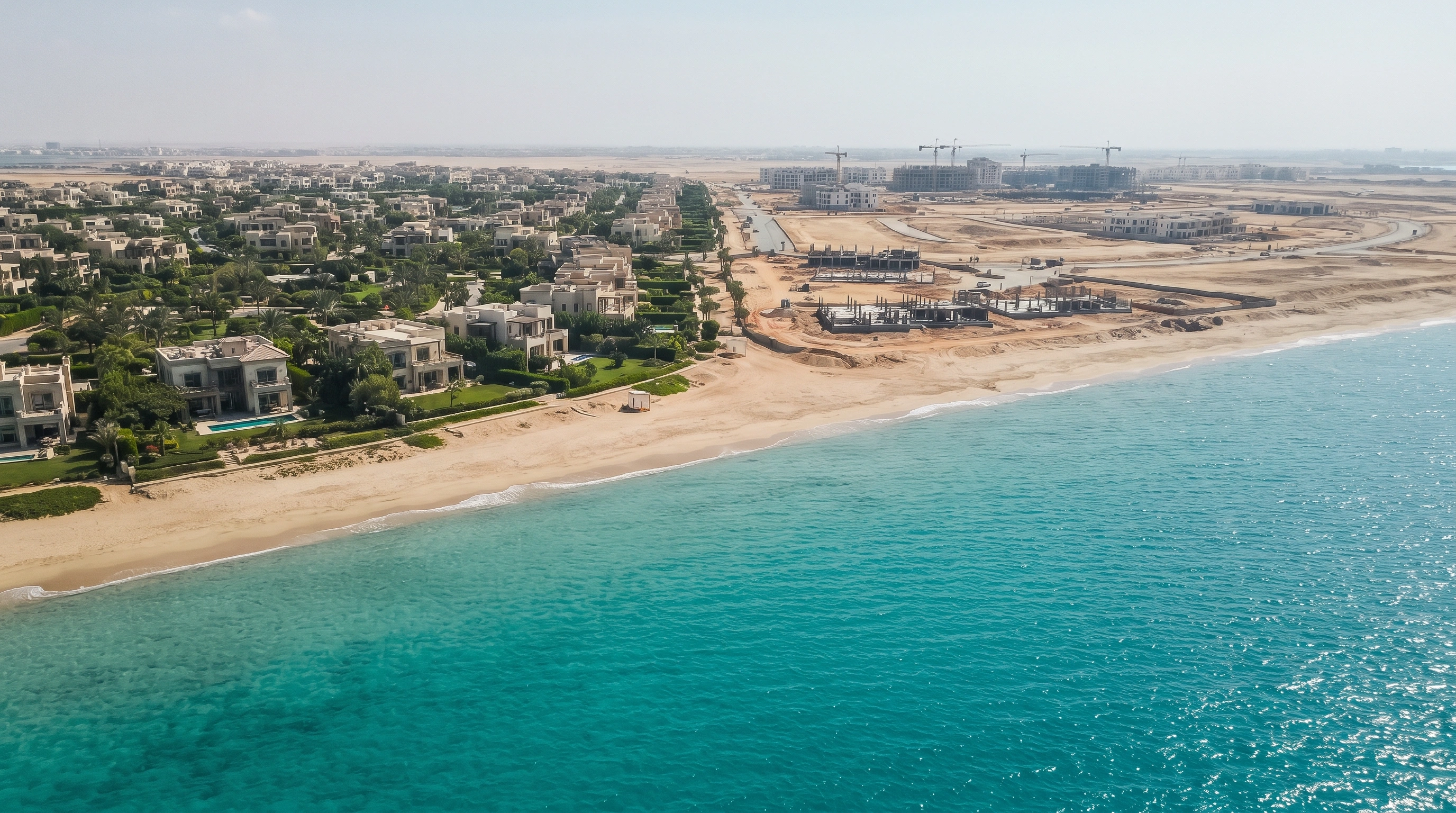
ERA continues active coverage of the Ras El Hekma corridor alongside the North Coast’s established stretches, and the two sit at different points on the delivery-stage spectrum that matters to the framework above. Modon’s masterplan for Ras El Hekma spans more than 44 kilometres of coastline across more than 17 precincts, including the Wadi Yemm precinct, alongside developments such as Ogami’s Bloom Island, Salt Marina and The Lighthouse Village. These are large-scale, comparatively newer developments, which generally means more choice of unit and phase set against an earlier point in the delivery timeline.
Established stretches such as Marassi, Hacienda and Silversands sit further along that same spectrum: a longer resale and rental track record, and generally more certainty sooner, set against less choice of phase and, often, a higher entry price for a comparable unit. Neither position on the spectrum is automatically the better financial decision. The right answer depends on the buyer’s own delivery-risk tolerance and time horizon from the framework above, not on which corridor happens to be newer or better marketed this season.
These are coverage notes on the development landscape, not price or availability claims. Unit-level availability changes by the week and should be confirmed on request for any specific development; foreign and non-resident ownership is possible in designated areas, subject to conditions and independent legal advice.
What Ownership Costs, Beyond the Purchase Price
Whichever way the primary-use decision lands, the categories of ongoing cost are the same; only their weight in the buyer’s mind should change. Beyond the purchase price, a North Coast owner should plan for: annual maintenance or service charges set by the development; utilities and club or beach access that continue through the months the unit sits empty; furnishing and periodic refresh costs; and, for an investment-first or mixed-use purchase, a management or letting fee if a third party is handling the rental.
ERA does not publish a rental-yield or expected-return figure for North Coast property in this guide, and treats any yield claim from elsewhere as something to verify, not accept, consistent with ERA’s evidence rules on rental yield and return claims. A holiday-first buyer should budget these costs against family use alone and treat any letting income as a bonus offset. An investment-first buyer should request a written cost breakdown from the specific development or management company before purchase, and compare it against realistic, dated occupancy assumptions rather than a developer’s illustrative example.
| Cost category | Applies to |
|---|---|
| Annual maintenance / service charge | All owners, from handover |
| Utilities, club and beach access | All owners, including the months the unit is empty |
| Furnishing and periodic refresh | All owners; heavier for a letting unit due to wear |
| Management or letting fee | Investment-first and mixed-use owners who let the unit |
| Caretaker arrangement | Holiday-first owners who do not let the unit |
Weighing the North Coast against other second-home markets?
ERA’s guide to Egypt’s second-home and investment appeal sets the wider context this decision sits inside.
Read: Holiday Homes in Egypt Message ERA on WhatsAppWhat Breaks the Combination: the Risks Worth Naming
An advisor who names no risks is selling, not advising. Four recur specifically where a holiday-first and an investment-first goal are asked to share a single unit.
Seasonality concentrates everything into a short window. Both family use and rental demand peak in the same summer months, which means a mixed-use unit has to be actively scheduled between the two rather than assumed to serve both automatically.
Delivery risk falls hardest on the investment case. A holiday-first buyer with a flexible timeline can absorb a delayed handover more easily than an investment-first buyer counting on a specific date to start recovering costs through letting.
Resale liquidity outside peak season is thinner. A unit bought purely for family use rarely needs to sell quickly; a unit bought with an exit expectation should be checked against real comparable resale activity, not assumed from the original sales pitch.
Management quality is uneven across developments. A caretaker arrangement that works for an empty holiday home is not the same as a professional letting operation, and assuming one covers the other is a common source of disappointment for owners based abroad.
None of these four is a reason to avoid the North Coast market. Each is a reason to decide, in advance, which goal takes priority when the two genuinely conflict on a specific unit.
How ERA Sequences This Decision
District Fit and Exit and Expansion Path are two of the nine components of the ERA Decision File, the framework ERA Real Estate Egypt uses to move a buyer from what is available to a decision that can be defended, alongside Demand Mapping, Supply Audit, Price Benchmarking, Cost Modelling, Risk Register, Timing Window and Negotiation Position. Applied to a North Coast second home, that means establishing the holiday-first or investment-first ranking before District Fit is even assessed, because “fit” means something different depending on which goal leads.
ERA Real Estate Egypt does not hold inventory and is not paid by a developer to move a specific unit. That independence is what allows this framework to be built around the buyer’s own stated priority rather than around whichever unit is easiest to sell this month, and our WhatsApp line works to a buyer’s own time zone rather than Cairo’s, so the conversation about what you actually want from the property can happen before, not during, a shortlisting trip.
Ready to rank your own priorities before you shortlist?
ERA Real Estate Egypt’s North Coast buyer advisory walks through the full decision framework, including cost modelling and exit planning, before you commit to a development.
See ERA’s North Coast buyer advisoryA Practical Checklist, Before You Shortlist a Single Unit
- Rank the purchase: mainly holiday home, mainly investment, or a deliberate mix, and write down which one wins when the two conflict.
- Match that ranking to a stretch of coast: established (Marassi, Hacienda, Silversands) for more certainty sooner, or Ras El Hekma corridor developments (Modon’s masterplan, Ogami Bloom Island, Salt Marina, The Lighthouse Village) for more choice of unit and phase.
- Size the unit to the ranking, not to the family’s largest imaginable gathering or to the highest theoretical rental yield.
- Request a written cost breakdown covering maintenance, utilities, and management or letting fees before comparing two opportunities on purchase price alone.
- If letting income matters to the decision, ask for real, dated occupancy and rate data from a management company, not a developer’s illustrative projection.
- Confirm foreign-ownership conditions with an independent Egyptian lawyer if you are a non-Egyptian buyer or hold dual nationality.
- Decide the management arrangement, caretaker or professional letting, before handover, not after the first empty season.
This checklist does not replace independent legal and financial due diligence; it exists to make sure the holiday-first or investment-first decision is made deliberately, before a unit is chosen, rather than discovered by accident afterward.
North Coast Egypt Second Home FAQ
Should I buy a North Coast Egypt property as a holiday home or an investment?
Decide which one comes first before you compare a single unit. A holiday-first purchase should be judged mainly on proximity to family, community feel and how the unit works when it sits empty most of the year. An investment-first purchase should be judged mainly on location within reach of rental demand, unit type and a realistic view of running costs against any income. The same property can serve both goals, but only when the buyer has ranked them, because location, unit type and finishing choices that suit one goal do not automatically suit the other.
Can both the Egyptian diaspora and foreign nationals buy property on Egypt’s North Coast?
Yes. The North Coast’s primary buyer is the Egyptian diaspora living in Europe, the United States and the Gulf, purchasing a second or third home back in Egypt. Foreign nationals are a secondary and growing segment. Egypt’s General Authority for Investment and Free Zones identifies Law No. 230 of 1996 as the legal basis for non-Egyptian ownership of constructed property, generally permitting up to two properties per foreign owner, each up to 4,000 square meters, for residential use, with some coastal land requiring presidential approval. This is general legal information, not a legal opinion on any specific unit; current conditions should be confirmed independently before reserving.
Does a North Coast Egypt property reliably generate rental income?
ERA does not publish a yield or return figure for North Coast property, and treats any such claim from a third party as something to verify, not accept. Rental demand on the North Coast is heavily seasonal, concentrated in a short summer window, and actual achieved rents depend on management quality, unit condition and marketing effort that a buyer based abroad usually cannot supply alone. A buyer weighing rental income as part of the decision should budget for a managed-letting arrangement and treat any income as a partial offset to ownership costs, not a return calculation, until real, dated letting data for the specific unit exists.
What is the difference between Ras El Hekma and established areas like Marassi, Hacienda and Silversands?
Marassi, Hacienda and Silversands are established North Coast stretches with a longer resale and rental track record, which generally suits a buyer who wants more certainty sooner. Ras El Hekma is a newer, larger-scale corridor, including Modon’s masterplan of more than 44 kilometres of coastline across more than 17 precincts and developers such as Ogami, Salt Marina and The Lighthouse Village, which generally suits a buyer comfortable with an earlier delivery stage in exchange for more choice of unit and phase. Neither is automatically the better financial decision; the right area depends on the buyer’s own delivery-risk tolerance and time horizon, not on which corridor is newer.
How much does seasonality affect a North Coast Egypt purchase?
Significantly, and in both directions. For a holiday-first buyer, a short season is simply the nature of the asset, since the unit is bought to be used during that window and can sit closed the rest of the year without changing its purpose. For an investment-first buyer, the same short season concentrates almost all achievable rental income into a few months, meaning the unit typically stands empty and still incurs maintenance, utilities and management costs for most of the year. Any decision that treats North Coast property like a year-round rental asset without accounting for this is working from the wrong assumption.
What should I decide before I start comparing specific North Coast units?
Rank your own priority first: mainly a family holiday home, mainly a financial asset, or a deliberate mix with a stated order between the two. That single decision changes which location, unit type, finishing level and delivery stage actually make sense, and it should happen before viewing units or comparing specific developments, not while comparing them. Buyers who skip this step tend to compare unlike properties on price alone and then feel the unit under-delivers on whichever goal they secretly cared about more.
Can the same North Coast unit work as both a holiday home and an investment?
Often, yes, but only when the buyer has consciously sequenced the two goals rather than assumed the unit will satisfy both equally. A common workable pattern is choosing a location and unit type that suits family use first, then accepting a managed-letting arrangement for the weeks the family will not use it, rather than choosing purely for rental yield and hoping it still feels like a family home. The order the buyer sets, not the property itself, is what makes the combination work.
Deciding between a holiday home and an investment on the North Coast?
Send ERA your family’s usage pattern and your financial expectation, whichever is stronger, and we will tell you which stretch of coast and unit type actually fits that ranking.
Message ERA on WhatsApp Explore ERA’s research reportsAbout ERA Real Estate Egypt
Each ERA Office is Independently Owned and Operated. ERA and the ERA logo are service marks of ERA Franchise Systems LLC