

Real estate market research Egypt developers commission before a launch rarely asks the question that matters most: not just whether the numbers work, but whether the buyer looking for exactly this project can actually find it. ERA Real Estate Egypt sees this gap most clearly on the North Coast, where a development’s own name can generate meaningful, measurable search demand for months before and after launch, and a developer with no visibility strategy captures little of it. The commercial cost is not abstract: it is demand that exists, is searchable, and goes to whichever page, agent or competitor shows up first.
This guide sets out what real estate market research Egypt should actually measure, how it differs from a standard feasibility study, a worked example using real, dated search-demand data for a live North Coast development, and a practical framework developers and project owners can use before committing to a launch calendar.
The Quick Answer: Know Your Buyer’s Search Before You Build
Real estate market research Egypt combines two things a developer usually commissions separately, and sometimes not at all: a market and demand study (who is buying, at what price, against what supply) and a visibility study (how, and how often, that buyer actually searches for a project like this one, by name, by district and by category, and who currently shows up when they do). Commissioning both together, before a launch date is set, tells a developer not only whether the project is financially sound but whether the buyer who wants it will be able to find it.
This matters because on categories like North Coast second homes, a meaningful share of demand arrives already named, a buyer searching for a specific development by name, not a generic district term, which means visibility is winnable or losable well before a single unit is marketed.
Who This Matters To: Developers and Project Owners
This guide is written for developers, co-developers and project owners evaluating a residential, mixed-use or resort development in Egypt, particularly on the North Coast, in New Cairo or in other high-launch-volume corridors where multiple projects compete for the same buyer’s attention in the same search results. It is equally relevant to a landowner considering a joint venture with a developer, since the same visibility gap affects whichever party ultimately markets the finished project.
It is not aimed at an individual buyer, though the underlying data in this guide, real, dated search-demand figures for a live development, is the same kind of evidence ERA uses when advising a buyer on which projects have genuine market traction versus which are simply well-advertised.
Real Estate Investment Egypt: The Investor’s Side of the Same Question
Real estate investment Egypt decisions run on a version of the same question a developer asks before a launch, whether the investor is a joint-venture landowner, a co-development partner or weighing a specific project directly: is there real, measurable demand behind this project, or mostly marketing. The demand-mapping and search-visibility evidence in this guide answers that question from the investor’s side of the table as directly as it does the developer’s, since a project with unclaimed search demand and a weak visibility plan is carrying a risk that any real estate investment Egypt decision should price in before committing capital, not discover after launch.
Feasibility Study Versus Visibility Study: What Each One Actually Checks
A standard feasibility study answers whether a project should be built: land cost, construction cost, absorption assumptions, pricing, and a return projection. A visibility study answers a narrower but commercially decisive question: once the project exists, will the buyer searching for it be able to find the developer’s own project page, or will they find someone else’s listing, a resale broker, or a competing development that ranks better for the same search.
The two studies are not substitutes. A financially sound project with no visibility strategy still loses buyers to whoever captures the search demand first, and a highly visible project built on unsound feasibility assumptions is still a bad investment. Commissioning them together, before a launch date is fixed, is what lets a developer sequence both the construction plan and the go-to-market plan against the same evidence base.
Want the full picture on Egypt’s real estate market intelligence approach?
ERA’s Market Intelligence advisory covers demand mapping, supply audits and price benchmarking as one integrated service.
Read: Egypt Real Estate Market IntelligenceA Worked Example: Marassi North Coast and Unclaimed Demand
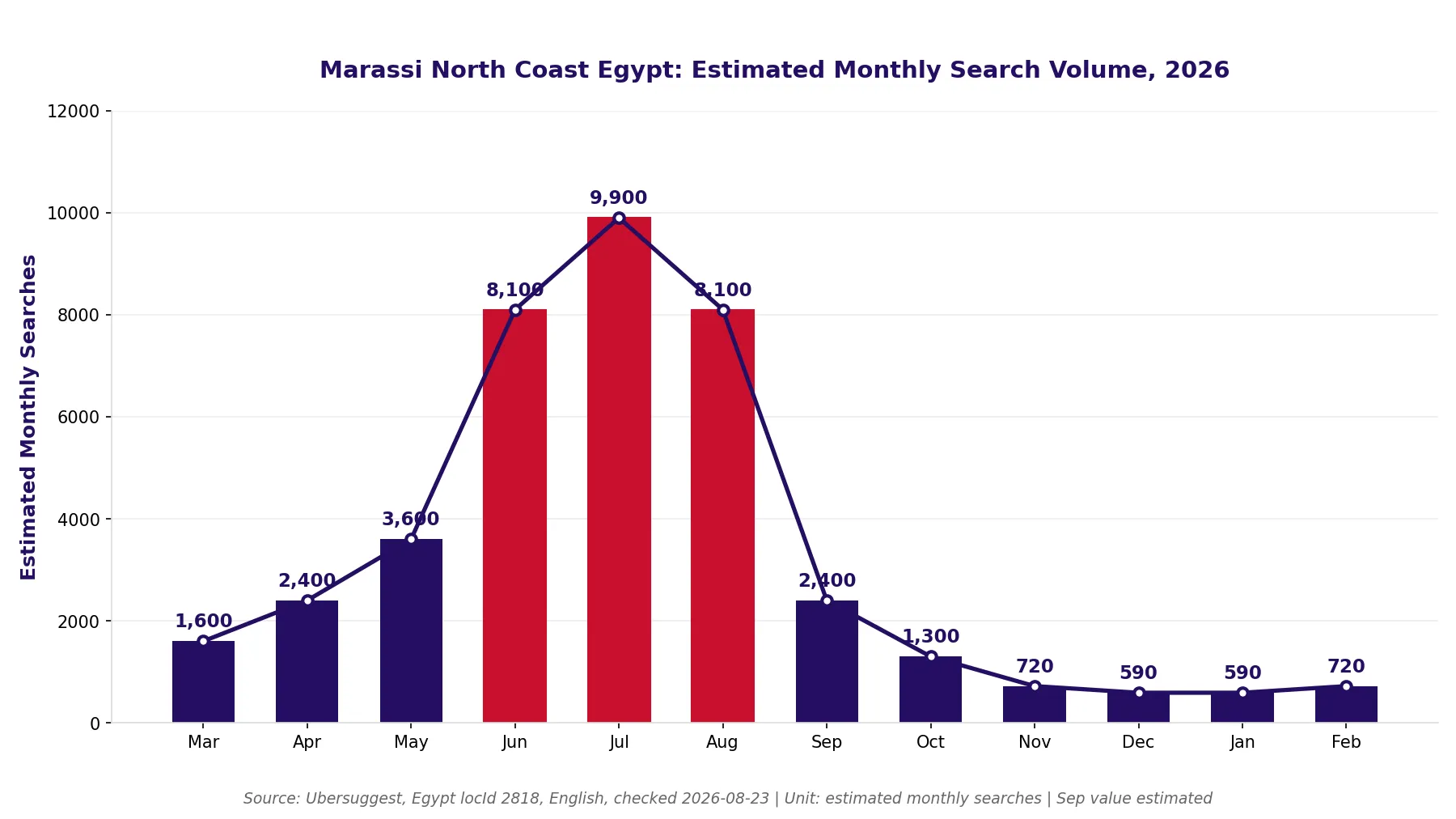
The clearest illustration ERA can point to sits inside a single search term. As of August 2026, the phrase “marassi north coast egypt” carries an average measured search volume of roughly 3,600 searches per month, rising sharply to a seasonal peak of 8,100 to 9,900 searches per month across June, July and August, and falling back to a low base of 590 to 720 searches per month in the November-to-February off season (source: Ubersuggest keyword data, Egypt location, English language, checked 2026-08-23).
| Month (2026) | Estimated monthly searches: “marassi north coast egypt” |
|---|---|
| March | 1,600 |
| April | 2,400 |
| May | 3,600 |
| June | 8,100 |
| July | 9,900 |
| August | 8,100 |
| September (est.) | 2,400 |
That is a named-development search term behaving like a category term, with real seasonal structure tied to the North Coast buying season. A development generating that level of branded search interest has, by definition, already won the hardest part of demand generation: people are actively looking for it by name. What happens next depends entirely on who is positioned to answer that search. A developer with a thin or outdated presence for its own project name effectively hands that traffic, and the buyer relationship attached to it, to resale brokers, listing portals or unrelated content that happens to rank instead.
This is the practical meaning of “unclaimed demand”: search volume that exists and is measurable, attached to a specific, named asset, that is not being systematically captured by the party with the most to gain from capturing it.
The scale of the gap becomes clearer when the seasonal swing is set against a typical launch and marketing calendar. Many developers concentrate marketing spend and content production around the launch event itself, then let the project’s own name go largely unattended in search for the rest of the year.
But the “marassi north coast egypt” pattern shows demand does not sit still: it triples between the spring shoulder months and the summer peak, then falls to roughly a fifth of its peak level by winter. A visibility plan built only around a single launch moment misses most of that curve, both the pre-season buyers researching early and the in-season buyers searching at volume while a developer’s attention has already moved to the next project.
ERA’s point in walking through this specific example is not that every project will match “marassi north coast egypt” search volume exactly. It is that this level of measurable, named demand is achievable and already happening in the market, which makes it a realistic benchmark for what a well-executed visibility strategy should be aiming to capture, not an outlier to be dismissed as unrepresentative.
What Real Estate Market Research Egypt Covers, Component by Component
Complete real estate market research Egypt developers can act on typically covers the following, run together rather than as separate, disconnected exercises.
| Component | What it establishes |
|---|---|
| Demand mapping | Who the realistic buyer is, by segment (end user, investor, diaspora, foreign national), and what they are actually searching for, by name, by district and by category |
| Supply audit | What is already built, under construction or announced in the same competitive set, so the project’s positioning is set against reality, not assumption |
| Search-visibility audit | How much measurable search demand exists for the project’s own name, its district and its category, and who currently ranks or shows up for those searches |
| Price benchmarking | Where the project’s pricing sits against comparable, currently marketed developments, distinguishing asking prices from any available transacted evidence |
| Timing window | Whether the launch calendar lines up with the searchable demand pattern (see the seasonal example above) or works against it |
Costs, Effort and the Limits of Search Data
ERA does not publish a fixed fee for real estate market research Egypt in this guide, since scope varies by project size, district and how much of the underlying demand and supply data already exists in usable form; a specific quote should be discussed directly. What is consistent across projects is the shape of the effort: a demand and supply desk study, a search-visibility audit run against real keyword and ranking data, and a benchmarking pass against comparable projects, typically completed as one combined exercise rather than three separate engagements.
Search-volume data of the kind used in the worked example above has real limits. It measures search interest, not confirmed buyer intent or transaction likelihood, and estimated monthly volumes from any keyword-data provider are directional rather than exact. It should be read alongside, not instead of, a proper feasibility study’s demand assumptions, and alongside first-party evidence such as actual enquiry volume once a project is live.
Effort also has a floor below which real estate market research Egypt stops being useful. A one-off keyword pull without a supply audit or a benchmarking pass tells a developer that demand exists, but not whether the project is priced to capture it or positioned against the right competitive set. The exercise is only as useful as the decisions it actually changes: a launch date moved to line up with the searchable season, a visibility budget sized to match the branded search opportunity, a pricing pass checked against current, not historical, comparable projects.
What It Costs to Launch Without One
Three patterns account for most of the value ERA sees lost when a development launches without real estate market research Egypt behind it.
Branded demand captured by someone else. As the worked example shows, a project’s own name can carry real, seasonal search volume. A developer with no visibility plan for that specific term routinely loses that traffic, and the leads attached to it, to resale listings, portals or unrelated content.
Launch timing working against the season. Search volume for North Coast developments is not flat across the year; it concentrates sharply in the months immediately before and during the buying season. A launch calendar set without reference to that pattern can miss the window when the most buyers are actively searching.
Positioning built on assumption rather than evidence. Without a supply audit and price benchmark run against real, current competitor data, a project’s pricing and positioning decisions rest on whatever the internal team assumes about the competitive set, which is frequently out of date by the time of launch.
How ERA Sequences Demand Mapping Into the Decision File
Demand Mapping is one of the nine components of the ERA Decision File, the framework ERA Real Estate Egypt uses to move a developer or investor from what is planned to a decision that can be defended with evidence, alongside Supply Audit, Price Benchmarking, District Fit, Cost Modelling, Risk Register, Timing Window, Negotiation Position and Exit and Expansion Path. Applied to a development launch, Demand Mapping means measuring the actual, searchable demand for the project’s name, district and category before the launch calendar is fixed, not after.
ERA’s Egypt Real Estate Market Intelligence advisory service runs this as an integrated exercise rather than a series of disconnected reports, precisely because a demand figure without a visibility plan attached to it is an observation, not a decision.
Evaluating feasibility for a specific site or asset class?
ERA’s Feasibility Advisory works alongside market and visibility research to test whether a project should be built at all.
Read: Egypt Real Estate Feasibility Advisory Message ERA on WhatsAppA Practical Checklist Before You Set a Launch Date
- Check the measurable search volume for your project’s own name, not just its district or category, and note whether it has seasonal structure.
- Identify who currently ranks or shows up for that search today, before your own marketing exists, so you know exactly what you are competing against.
- Map that search-demand pattern against your planned launch date. A launch that lands ahead of the seasonal peak captures rising search interest; one that lands after it does not.
- Run a supply audit against current, not historical, competitor listings and launches in the same corridor.
- Benchmark pricing against comparable current asking prices, clearly distinguishing asking data from any transacted evidence you can access.
- Build a visibility plan, not just a media plan, for your project’s own name specifically, so branded search demand is captured rather than ceded by default.
This checklist does not replace a full feasibility study; it exists to make sure a financially sound project also has a plan to be found by the buyer already looking for it.
Real Estate Market Research Egypt: FAQ
What is the difference between a feasibility study and a visibility study?
A feasibility study tests whether a project makes financial sense: cost, pricing, absorption assumptions and return. A visibility study tests whether the buyer who wants that specific project will be able to find it, by measuring real search demand for the project’s name, district and category and who currently captures it. Real estate market research Egypt should therefore combine both: whether to build and how the project will actually be found once it exists.
How much search demand can a single development’s name really generate?
It varies by project and market recognition, but the worked example in this guide shows a real, live North Coast development generating an average of roughly 3,600 searches per month, rising to 8,100 to 9,900 per month in peak summer season (Ubersuggest keyword data, Egypt location, checked 2026-08-23). Not every project will match this, but it illustrates that branded search demand for a specific development is a measurable, sometimes substantial, figure, not a rounding error.
What does “unclaimed demand” actually mean?
It means measurable search volume exists for a specific project’s name, but the developer or its marketing partners are not systematically positioned to capture it, so that traffic and the leads attached to it go to resale brokers, listing portals or unrelated content instead.
Does search-volume data predict actual sales?
No. Search volume measures interest and intent to find information, not confirmed buyer intent or a guaranteed sale. It is a directional demand signal that should be read alongside a proper feasibility study and first-party evidence such as real enquiry volume once a project is live, not as a standalone sales forecast.
When should a market and visibility study be commissioned relative to launch?
Before the launch calendar is fixed, ideally early enough that the timing window, whether the launch lands ahead of or after the searchable demand’s seasonal peak, can still be adjusted based on what the study finds.
Does this apply outside the North Coast?
Yes. The same demand-mapping and visibility-audit logic applies to New Cairo, New Capital and other high-launch-volume corridors; the North Coast example in this guide is used because its seasonal search pattern is unusually clear and well documented, not because the method is North Coast-specific.
Want the real estate market research Egypt developers rely on for your own project?
Message ERA on WhatsApp to start your own real estate market research Egypt project, or explore ERA’s research reports for the wider absorption picture.
Message ERA on WhatsApp See ERA’s Research ReportsAbout ERA Real Estate Egypt
Each ERA Office is Independently Owned and Operated. ERA and the ERA logo are service marks of ERA Franchise Systems LLC